
Best heat sources & thermostats for ball pythons
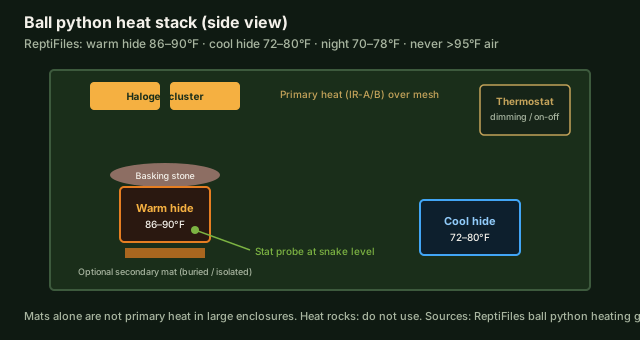
In a modern-sized enclosure, an under-tank mat alone rarely builds a safe ambient gradient. ReptiFiles ranks overhead halogen (or similar IR-A-rich lamps) as the primary tool, with a thermostat-controlled mat only as secondary warm-hide help — never heat rocks.
Quick comparison
| Gear | Role | Pros | Cons | Verdict |
|---|---|---|---|---|
| Halogen / incandescent flood cluster | Primary daytime heat | Strong IR-A/B; warms air + surface; ReptiFiles “good/best” path with dual bulbs on enclosures >36″ | Wattage is room- and height-dependent; use ceramic fixtures; cage bulbs if mounted inside | Primary |
| Deep heat projector / CHE (night) | Lightless supplemental / night ambient | Useful if room drops below ~70°F; no bright glare | Weaker IR spectrum than halogen for “basking”; still needs a thermostat | Night / ambient |
| UTH / Ultratherm-style heat mat | Secondary warm-hide assist | Helps hold hide temps when overhead alone isn’t enough; common spare parts | IR-C only; unsafe as sole heat in large deep-substrate builds; burn risk without a thermostat | Secondary only |
| Radiant heat panel | Broad overhead warmth | Good for large PVC cages; lower contact-burn profile than mats; Bean Farm / VE-style panels | Must use a proportional/dimming thermostat (manufacturer FAQs); weaker than halogen as “sunbeam” | Okay / large cages |
| Herpstat-class dimming / pulse thermostat | Control | Proportional control, alarms, safer failure modes than bare mats; ReptiFiles highlights Herpstat 1 for quality | Higher cost than basic plug-in stats | Best control |
| Inkbird-style on/off thermostat | Control for mats | Affordable; acceptable for many heat mats per ReptiFiles | On/off cycling is a poor match for visible light bulbs | OK for mats |
| Heat rocks | — | — | ReptiFiles: do not use — burn risk and poor ambient heating | Do not use |
Halogen flood bulbs + dual ceramic dome
ReptiFiles lists options such as Arcadia GoldenSun, Reptile Systems Eco Halogen, and widely available halogen floods, and suggests a dual deep-dome (e.g. Zoo Med Combo Deep Dome) over mesh so two bulbs create a basking area large enough for a coiled adult. Pick wattage by measuring — not by copying someone else’s setup. Prefer clear/white glass over colored “night” bulbs.
Ultratherm / quality heat mat (secondary)
Use only to help the warm hide after overhead heat is in place. ReptiFiles’ rules: never primary in large enclosures; prevent direct belly contact (bury ~1″ under substrate or isolate on/under the hide stack); thermostat required; probe inside the hide on the substrate — not taped to the mat face.
Spyder Robotics Herpstat 1 (or multi-channel Herpstat)
Proportional dimming or pulse modes, soft start, alarms, and a safety relay — suited to lamps and many heat devices. Manufacturer lists roughly 40–150°F usable control range with fine resolution. Pair with an independent IR gun + probe thermometer for verification.
Inkbird-style on/off thermostat (mat duty)
ReptiFiles notes many keepers use lower-cost non-proportional stats such as Inkbird on heat pads. Fine for mats; do not put a bright halogen on a simple on/off outlet if you care about flicker and bulb life — use dimming for lamps.
Safety
Unregulated mats have melted tubs and scorched shelves (ReptiFiles recounts exactly that failure mode). Radiant heat panels need proportional thermostats per panel makers’ FAQs. Air in the enclosure should not exceed 95°F / 35°C.
Related
Bearded dragon heat · Thermometers · Leopard gecko enclosures