
Thermometers & hygrometers for bearded dragons
You cannot dial in a gradient with the sticky dial that came free in a kit. Use digital probes for ambient zones and an infrared thermometer for basking surface temperature.
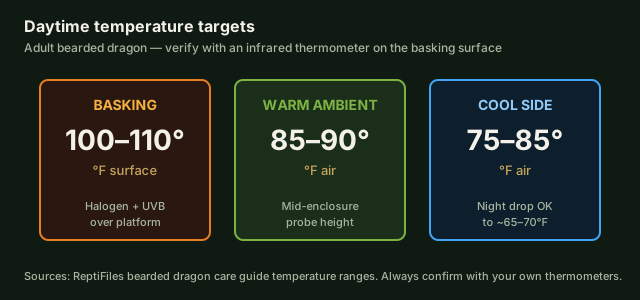
Quick comparison
| Tool | Measures | Where to use | Limitations | Verdict |
|---|---|---|---|---|
| Zoo Med Digital Combo (TH-31 style) / dual probe meters | Air temp + humidity via probes | Warm mid-level and cool side | Probe placement makes or breaks accuracy; LCD must stay dry | Daily driver |
| Infrared temperature gun | Surface temperature | Basking slate / platform | Emissivity and aim matter; not a substitute for ambient probes | Required for bask |
| Controller probe (Herpstat etc.) | Control sensor | Near basking zone for thermostat | Controls heat — still verify with a second thermometer | Part of heat system |
| Analog stick-on dial | “Something” | Nowhere important | Slow, inaccurate, measures glass more than air | Decorative only |
Zoo Med Digital Combo Thermometer Humidity Gauge
Zoo Med’s TH-31-style combo uses remote probes for temperature and humidity so the display can sit outside the enclosure. Manufacturer notes a waterproof temp probe usable in air or water and a stated sensing range roughly −10 to 140°F — plenty for dragon gradients when placed correctly.
Infrared thermometer (temp gun)
Point at the basking surface after the lamps have stabilized. Cross-check against your thermostat setpoint. Cheap guns vary in quality — pick a unit with a clear laser aim and a range that covers at least up to ~150°F.
Placement cheat sheet
- Basking: IR gun on the platform surface where the dragon sits.
- Warm ambient: probe at roughly dragon mid-body height on the warm half — not touching the lamp.
- Cool side: probe on the opposite end, same height.
- Humidity: arid species still need monitoring; chronically high humidity can stress dragons — keep an eye on spikes after misting or bioactive watering.