
Best heat lamps & thermostats for bearded dragons
Adult dragons need a hot basking surface and a cool side they can escape to — controlled safely. Halogen flood lamps and deep heat projectors, paired with a quality dimming thermostat, are the modern baseline.
Quick comparison
| Gear | Role | Pros | Cons | Verdict |
|---|---|---|---|---|
| Halogen flood (e.g. parasol / flood style basking lamp) | Primary basking beam | Bright, focused heat + visible light; easy to aim at a platform | Bulbs burn out; needs correct wattage + thermostat | Primary heat |
| Deep Heat Projector (DHP) | IR-A/B style supplemental or primary heat | No bright glare; useful for night support if temps drop too far | Still needs a thermostat; not a UVB source | Strong option |
| Dimming thermostat (e.g. Herpstat-class) | Controls heat output | Proportional control, alarms, safer than unregulated lamps | Higher upfront cost than a plug timer | Non-negotiable |
| On/off mat thermostat on a basking lamp | Wrong tool | Cheap | On/off cycling hammers bulbs; poor for radiant lamps | Wrong match |
| Colored “night” bulbs as daytime heat | Marketing leftover | — | Disturb sleep; not a substitute for a proper gradient | Skip |
Halogen basking lamp + ceramic fixture
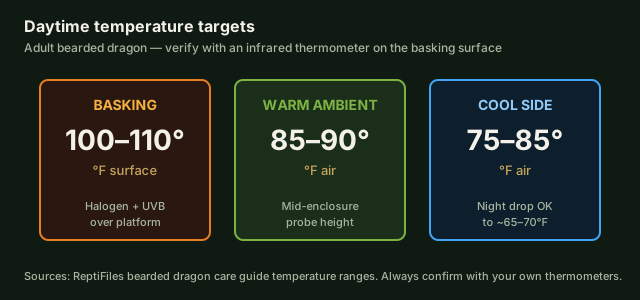
A halogen flood aimed at a slate or wood basking platform is the usual daytime primary. Choose wattage for your enclosure height and ambient room temp, then let a dimming thermostat hold the surface target (commonly cited adult basking surfaces around 100–110°F / ~38–43°C per ReptiFiles-style ranges).
Arcadian / Zoo Med-style Deep Heat Projector
Deep heat projectors emit infrared with little visible light. Keepers use them as primary or supplemental heat under thermostat control. Confirm fixture rating (ceramic socket) — these run hot at the base.
Spyder Robotics Herpstat (dimming / pulse)
Herpstat 1 (and multi-channel siblings) offer proportional dimming or pulse modes, soft start, alarms, and a safety relay — purpose-built for herp heat. Manufacturer lists a usable control range roughly 40–150°F with fine resolution. Pair the probe near the basking zone (not inside the lamp).
Safety
Never run unregulated high-wattage heat. Use ceramic-rated fixtures, secure lamp cages if the dragon can reach bulbs, and place probes where the animal actually basks — not on the cool glass wall.
Related
Sources
- ReptiFiles — Bearded Dragon Care Sheet (temperature gradient guidance)
- Spyder Robotics — Herpstat 1 product page
- Manufacturer pages for halogen basking lamps and deep heat projectors (fixture wattage ratings)